
8
Every modern vehicle is an exercise in kinetic energy management. Accelerating a two-ton machine to highway speeds requires significant mechanical output, but bringing that same mass to an immediate, controlled stop demands an even greater feat of thermal physics. Drivers routinely monitor fuel levels, track engine oil intervals, and wash road salt from exterior paint, yet they frequently take the braking system entirely for granted. The system is expected to perform flawlessly across every stop sign, downhill descent, and sudden highway deceleration without complaint.
Treating brakes as an afterthought until performance noticeably deteriorates transforms a routine maintenance task into an urgent safety risk. A vehicle’s stopping distance directly dictates the boundary between a controlled near-miss and a severe collision. Beyond immediate safety concerns, neglect carries compounding financial penalties. By understanding the mechanical forces at play, recognizing early indicators of component wear, and adhering to systematic inspection routines, vehicle owners can preserve pedal responsiveness, extend hardware longevity, and avoid costly emergency repairs.
The Physics of Stopping: Friction, Heat, and Component Wear
Automotive braking systems operate on a simple principle: converting kinetic forward momentum into thermal energy through friction. When a driver presses the brake pedal, the master cylinder pressurizes hydraulic fluid throughout the brake lines. This hydraulic force activates the brake calipers at each wheel, driving hydraulic pistons outward to clamp sacrificial brake pads against cast-iron or composite brake rotors.
This friction generates extreme heat. Under normal city commuting conditions, brake temperatures easily range between 300°F and 500°F. During aggressive highway stops, heavy vehicle towing, or continuous downhill mountain driving, temperatures can exceed 1,000°F.
Because brake pads are engineered to wear away gradually to preserve the rotor, their friction material—typically composed of semi-metallic compounds, ceramic formulations, or organic fibers—erodes with every stop. The rate of this erosion varies widely depending on vehicle curb weight, driving habits, geographical terrain, and ambient weather. When friction material wears past its operational limits, the steel backing plate of the pad contacts the rotating cast-iron disc, instantly compromising stopping power and causing irreversible damage to the underlying hardware.
Primary Warning Signs of Impending Brake Failure
Braking assemblies rarely fail without giving distinct warnings. Modern engineering incorporates mechanical and tactile cues designed to alert drivers long before catastrophic failure occurs.
Audible Cues
Automotive brake pads are equipped with small, spring-steel tabs known as acoustic wear indicators. When the friction material wears down to approximately two to three millimeters of remaining thickness, this metal tab rubs directly against the spinning rotor during deceleration, emitting a persistent, high-pitched squeal. Ignoring this high-frequency squeal eventually leads to a harsh, metallic grinding noise. A grinding noise indicates that the friction material has been completely worn away, meaning the bare steel backing plate is gouging deep structural grooves directly into the rotor face.
Tactile Feedback and Pedal Travel
The brake pedal serves as a direct communication line to the hydraulic system:
-
Spongy or sinking pedal: If the pedal feels soft, lacks firm resistance, or slowly sinks toward the floorboard while waiting at a red light, air or moisture has entered the hydraulic lines, or the master cylinder’s internal rubber seals are failing.
-
Low pedal engagement: If the vehicle requires pushing the pedal unusually far down before deceleration begins, the brake pads are either severely worn or rear drum brake shoes require mechanical adjustment.
-
Hard or resistant pedal: A pedal that requires immense physical effort to depress usually indicates a failure within the vacuum brake booster or a restricted hydraulic check valve.
Vibration, Pulsation, and Directional Pull
When braking at highway speeds, a rhythmic pulsation through the brake pedal or a violent shudder in the steering wheel indicates disc thickness variation (DTV). Often incorrectly referred to as a warped rotor, this condition occurs when uneven friction material deposits onto the rotor face, or when the rotor suffers from lateral runout. As the brake pads clamp against uneven rotor surfaces, the alternating high and low spots push back through the hydraulic fluid, vibrating through the pedal assembly.
Similarly, if a vehicle sharply pulls to the left or right when the brakes are applied, a brake caliper has likely seized. When caliper slide pins lose lubrication or a caliper piston corrodes in its bore, the caliper cannot apply equal clamping pressure across both sides of the axle, pulling the car toward the side that is doing all the work.
Brake Fluid: The Forgotten Hydraulic Lifeline
While vehicle owners occasionally inspect pad thickness, brake fluid is often ignored until major hydraulic components fail. Standard automotive brake fluid is a specialized, glycol-based hydraulic liquid that must remain incompressible under extreme pressures and resist boiling at high operating temperatures.
However, glycol-based brake fluid is inherently hygroscopic, meaning it continuously pulls ambient moisture out of the air through microscopic pores in flexible rubber hoses, caliper seals, and master cylinder reservoir vents. Over two to three years of real-world driving, brake fluid can easily absorb two to four percent water content.
Moisture contamination creates two major hazards:
-
Vapor lock and boiling brake fluid: Water boils at a far lower temperature than pure brake fluid (212°F compared to well over 400°F for fresh fluid). During heavy braking, the intense heat transferred from the caliper into the fluid causes contaminated water to boil, instantly converting liquid into compressible steam pockets. When the driver presses the pedal, the pedal sinks to the floor without generating hydraulic clamping force—a condition known as fluid vaporization or brake fade.
-
Internal corrosion: Moisture corrodes the delicate, precision-machined steel valves within anti-lock braking (ABS) modules and attacks aluminum caliper bores, creating internal fluid leaks and expensive electrical fault codes.
Performing a full hydraulic brake fluid flush every two to three years or 30,000 miles eliminates moisture, maintains high fluid boiling points, and safeguards expensive ABS distribution blocks.
What a Comprehensive Brake Inspection Entails
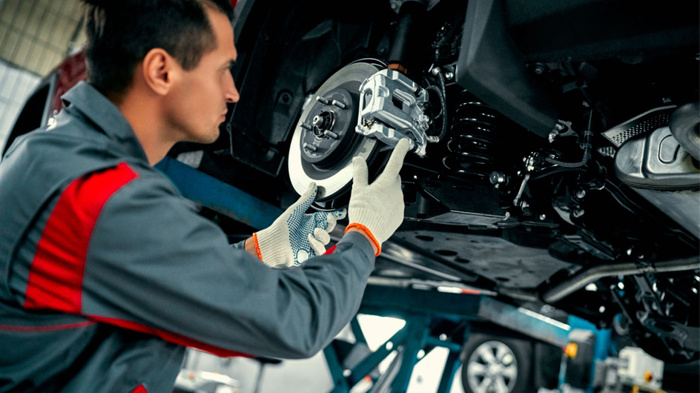
A proper brake inspection involves far more than shining a flashlight through an alloy wheel spoke to glance at the outer pad. A visual check through the wheel only reveals the outer friction pad; the inner pad, which frequently wears faster due to sticky caliper slide pins, remains completely hidden from view.
A professional, wheels-off inspection should include:
-
Micrometer rotor measurements: Technicians use a precision digital micrometer to measure the exact thickness of the brake rotor across multiple points, comparing the result against the manufacturer’s cast-in minimum discard thickness. Rotors that have worn below this threshold lack the thermal mass needed to dissipate heat effectively and risk cracking under sudden stress.
-
Slide pin cleaning and relubrication: Caliper slide pins must move freely within their rubber boots. Technicians clean out hardened grease and apply high-temperature, silicone-based ceramic lubricant to prevent binding and uneven pad wear.
-
Hardware clip replacement: Stainless steel abutment clips lose their spring tension over thousands of heat cycles. Replacing these inexpensive clips during pad service prevents pad rattle, reduces brake drag, and ensures the pads retract cleanly when the pedal is released.
-
Inspection of flexible rubber lines: Inspecting the flexible hydraulic lines at each wheel for exterior dry rot, cracking, blistering, or internal restriction prevents sudden high-pressure fluid leaks.
Protecting Your Safety and Your Wallet
The financial argument for routine brake maintenance is straightforward. Replacing brake pads at the four-millimeter mark is an inexpensive, routine service. Waiting until the pads are worn to bare metal transforms that simple job into an extensive overhaul requiring new rotors, remanufactured calipers, hydraulic system bleeding, and possibly new ABS wheel-speed sensors.
The most effective maintenance strategy is pairing a visual brake inspection with every routine tire rotation, roughly every 5,000 to 7,500 miles. Because the wheels are already dismounted from the hubs, inspecting pad depth, checking rotor surfaces for scoring, and inspecting hydraulic lines requires only minutes of additional labor.
Brakes are the primary safety system on your vehicle. By paying attention to early acoustic warnings, recognizing changes in pedal feel, and treating brake fluid as a consumable fluid with a finite lifespan, you ensure that your vehicle remains predictable, responsive, and completely safe under all driving conditions.
